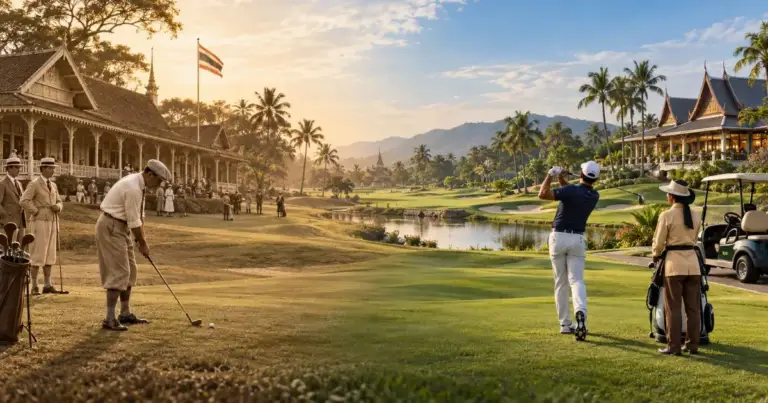


Golf has been played in Thailand for more than a century. The earliest organised golf setting clearly documented in the historical sources reviewed for this guide is Chiang Mai Gymkhana Club, where golf has been played since the club’s founding in 1898. The Royal Bangkok Sports Club opened a golf course in 1906, while Royal Hua Hin later developed what the club describes as Thailand’s first standard golf course. From those early sporting clubs, golf expanded into private courses, professional competition, tourism, junior development and a distinctive Thai golf culture in which caddies, service and social interaction remain central to the experience.
The history of golf in Thailand is often reduced to one neat story: golf arrived with foreign residents, Royal Hua Hin became the country’s first course, and Thailand eventually developed into an international golf destination.
The reality is more interesting.
Golf did arrive in Siam through international sporting influences, but Thai nobles, the monarchy and local institutions were involved surprisingly early. The sport then evolved through several different phases: expatriate and elite sporting clubs, domestic recreational golf, national golf organisations, privately developed courses, professional tours and finally the large modern golf economy visible across Thailand today.
Understanding that history also explains why golf in Thailand now feels different from playing in many Western countries. The caddie system, staffed club operations, social clubhouse culture, widespread visitor access and strong relationship between golf and hospitality did not appear overnight. They developed as the game itself became part of modern Thai leisure, business, sport and tourism.
One important historical distinction: “the first golf played in Thailand,” “the oldest golf club,” “the first golf course” and “Thailand’s first standard golf course” are not necessarily the same thing. Different historical institutions can legitimately appear in Thailand’s golf story depending on which definition is being used.
When Did Golf Begin in Thailand?
The earliest organised golf setting clearly documented in the sources reviewed for this article dates to 1898. Chiang Mai Gymkhana Club states that golf has been played on its grounds since the club was founded on 5 April 1898.
That does not necessarily prove that nobody hit a golf ball anywhere in Siam before that date. Historical records from the period are incomplete. It does, however, give us a much stronger starting point than the frequently repeated claim that golf in Thailand began in Hua Hin during the 1920s.
The Chiang Mai club emerged from the unusual social world of northern Siam at the end of the 19th century. Its fourteen founders included traders, diplomats, government foresters and a Thai nobleman. The 90-rai site near the Ping River was granted by Chao Intawaroros Suriyavongse, Prince of Chiang Mai, with the formal blessing of King Chulalongkorn, Rama V, for the encouragement of sport.
Golf was not the site’s only purpose. The grounds were shared with activities including cricket and polo, which is why Chiang Mai Gymkhana should not be imagined as a purpose-built modern golf facility from its first day.
This is an important theme in the early history of Thai golf. The game initially existed as one part of broader sporting institutions rather than as the large standalone golf-course developments familiar today.
Bangkok soon followed.
King Chulalongkorn granted the Royal Charter establishing the Royal Bangkok Sports Club in 1901. The club began with horse racing and other sports, before opening its golf course in 1906. In 1926, RBSC records King Prajadhipok, Rama VII, becoming the first Thai ruler to play a round of golf on its course.
The evidence therefore points not to one single person “introducing golf to Thailand,” but to a gradual adoption of the sport through international communities and Thai institutions during a period when Siam was increasingly engaging with modern international sports.
A Timeline of Golf in Thailand
Chiang Mai Gymkhana Club is founded on 5 April. The club states that golf has been played on its grounds since its founding, making this the earliest organised golf setting clearly documented in the sources reviewed for this article.
The Royal Bangkok Sports Club receives its Royal Charter from King Chulalongkorn in 1901 and opens its golf course in 1906.
Construction of Royal Hua Hin’s first nine holes begins in 1919. They open in 1922, the course is inaugurated in 1924, and the second nine are completed in 1928. The club describes Royal Hua Hin as Thailand’s first standard golf course.
The Royal Bangkok Sports Club records King Prajadhipok, Rama VII, as the first Thai ruler to play a round on its golf course.
RBSC establishes its first Ladies’ Golf Subcommittee in 1948. The International Golf Federation dates the founding of the Thailand Golf Association to 1956, while the organisation that eventually became the Professional Golf Association of Thailand traces its beginnings to a group of professional golfers and instructors in 1968.
Siam Country Club Old Course opens near Pattaya. Siam Country Club describes it as Thailand’s first privately owned golf course, an important milestone in the shift toward privately developed golf facilities.
Blue Canyon’s Canyon Course opens in Phuket in 1991 and hosts the Johnnie Walker Classic in 1994 and 1998. Tiger Woods competes there as an amateur in 1994 and wins the tournament when it returns in 1998. Blue Canyon later hosts the event for a third time in 2007.
Thongchai Jaidee becomes the first Thai winner on the European Tour in 2004. Ariya Jutanugarn becomes Thailand’s first LPGA Tour winner and first major champion in 2016. Kiradech Aphibarnrat becomes the first Thai golfer to earn a PGA TOUR card in 2018.
Thai professionals compete at the highest levels of men’s and women’s golf, structured junior development operates across the country, Thailand continues to host international tournaments, and the Tourism Authority of Thailand reported more than 250 golf courses nationwide in September 2026.
The timeline shows why no single course or decade tells the complete story. Thai golf developed through overlapping phases of sporting clubs, institutional support, domestic participation, private investment, international competition and tourism.
What Is the Oldest Golf Course in Thailand?
There is no accurate answer unless “oldest” is defined first.
Three historic institutions are especially important, but their claims describe different things.
Royal Hua Hin nevertheless occupies a special place in Thai golf history.
Its official account says construction of the first nine holes began in 1919 under the initiative of Krom Phra Kamphaengphet Akarayothin with the approval of King Rama VI. A.O. Robin, identified by the club as a Phetchaburi Railway officer, designed the course. The first nine opened in 1922, King Rama VI inaugurated the course in 1924, and the final nine were completed during the reign of Rama VII in 1928.
Royal Hua Hin therefore represents something different from Chiang Mai Gymkhana’s multi-sport origins or RBSC’s metropolitan sporting-club setting: the emergence of a dedicated, standard golf course associated with one of Thailand’s early resort towns.
That is why describing Royal Hua Hin as Thailand’s first standard golf course is both historically stronger and more useful than simply calling it the first place golf was played.
How Did Golf Grow From a Club Sport Into a Thai Golf Industry?
For the first half of the 20th century, golf remained closely associated with established clubs, elite leisure and relatively limited participation. Over time, however, the institutions around the game became more formal and the number of people involved expanded.
The Royal Bangkok Sports Club provides one useful historical snapshot. It established its first Ladies’ Golf Subcommittee in 1948, and by 1961 recorded roughly 600 male and 100 female golfers in its golf section. Those figures describe one club rather than the whole country, but they show that organised domestic golf had developed considerably before the modern tourism boom.
National structures followed.
The International Golf Federation records the Thailand Golf Association as founded in 1956. The Professional Golf Association of Thailand traces its own roots to 1968, when professional golfers who also worked as instructors formed an organisation originally known as the Golf Teachers Association.
The next major transition involved ownership and development.
Siam Country Club Old Course opened near Pattaya in 1971 and is described by the club as Thailand’s first privately owned golf course. That milestone anticipated a much larger transformation: golf increasingly became part of privately financed leisure developments rather than something found mainly inside traditional sports clubs.
Academic research provides unusually useful evidence for what happened next.
In his 1995 peer-reviewed study Golf in Thailand: From Sport to Business, sociologist Erik Cohen examined how Thai golf facilities were changing from relatively simple sporting establishments into large integrated leisure developments connected with property, weekend residences and a growing mobile urban middle class.
That transition helps explain the geography of modern Thai golf.
Courses began to appear not only where traditional clubs existed, but around expanding cities, tourism centres, residential projects and new leisure destinations. Bangkok and its surrounding provinces developed a deep concentration of courses. Pattaya and the Eastern Seaboard expanded substantially. Hua Hin’s much older golf tradition was joined by modern championship layouts. Chiang Mai developed beyond its historic Gymkhana roots, while Phuket became an internationally visible resort-golf destination.
One of the clearest symbols of this newer era opened in Phuket in 1991.
Blue Canyon Country Club’s Canyon Course was created by Japanese architect Yoshikazu Kato on land that had previously been used for tin mining. Within only a few years it was hosting the Johnnie Walker Classic, bringing internationally recognised professional golfers to Thailand in 1994, 1998 and again in 2007.
By then, Thai golf was no longer simply expanding. It was becoming internationally visible.
How Did Thailand Become an International Golf Destination?
Thailand did not become a golf-tourism destination in one particular year. The process accelerated during the late 20th century as private course development, international tourism, resorts, improved transport and professional tournaments began reinforcing one another.
That distinction matters because golf tourism was a consequence of a golf infrastructure that had already been developing for decades.
By the 1990s, Thailand could offer something increasingly attractive to visiting golfers: modern golf courses in established tourism regions, hotels and resorts nearby, professional course operations, caddie-supported play and a hospitality industry already accustomed to international guests.
International course architects also became increasingly visible. Championship-style projects were developed around Bangkok, Pattaya, Hua Hin, Phuket and Chiang Mai, while tournaments exposed selected Thai venues to golfers overseas.
Golf could consequently become one part of a larger Thailand trip rather than requiring travel to an isolated specialist resort.
Another important factor was access.
Thailand still has private and membership-oriented clubs, but much of its modern commercial golf infrastructure developed around courses that could accommodate visitors. That differs from markets where many of the most desirable courses are difficult for non-members to access.
The country’s established caddie system and highly staffed club operations also lowered the practical barrier for visiting golfers. A player unfamiliar with the course could arrive, be assigned a caddie, use established locker and clubhouse facilities and play without needing detailed local knowledge beforehand.
Golf tourism eventually became structured enough to receive its own national trade promotion. The Tourism Authority of Thailand’s Thailand Golf Travel Mart now brings international golf-travel buyers together with Thai golf courses, hotels, resorts and tourism businesses.
At the September 2026 event, TAT reported that Thailand had more than 250 golf courses and presented the country through golf regions stretching from the North and Northeast to the South, Central Plains and Eastern Seaboard.
For travellers choosing between those regions today, our Thailand golf destination guide covers the practical differences. The important historical point is that those destinations are the product of different stages of Thai golf development rather than one centrally planned golf-tourism model.
Why Are Caddies So Important to Golf Culture in Thailand?
Caddies are one of the defining features of modern golf in Thailand, but the precise origin of the present system is surprisingly difficult to document.
Stories are sometimes repeated claiming that Thailand’s nationwide caddie culture began because of one particular government employment policy. We could not verify that simplified explanation strongly enough from authoritative historical sources to present it as fact.
What is clear is how deeply the caddie became embedded in the modern operating model of Thai golf courses.
At major clubs such as Siam Country Club, a caddie is required for each golfer. The club describes its caddies as providing course strategy, tee-shot lines, yardages, green reading, club and ball cleaning, divot repair and detailed local course knowledge.
That is considerably broader than the traditional idea of somebody who simply carries a golf bag.
At many Thai courses, the caddie becomes the golfer’s main point of contact throughout the round. Experienced caddies know green contours, preferred landing areas, safe misses and how the course behaves in different conditions. Where carts are used, caddies frequently operate them as part of the normal course routine.
The social relationship matters too.
For international golfers, several hours of interaction with the same caddie can become one of the most memorable parts of playing in Thailand. For Thai golfers, the caddie system is simply an established part of how many courses operate.
From Fairways of Eden’s day-to-day work with golfers and golf courses, this remains one of the clearest differences first-time visitors notice. The round feels highly supported because the golfer is rarely left to navigate an unfamiliar course entirely alone.
That does not mean every caddie provides the same experience or that every Thai course operates identically. Caddie policies, cart rules and service standards still vary by club.
For current practical information rather than history, see our complete Golf Caddies in Thailand guide. Current gratuity expectations are covered separately in our Tipping in Thailand Golf guide.
How Did Golf Become Part of Thai Social and Club Culture?
Golf in Thailand has been social almost from the beginning.
Chiang Mai Gymkhana was created not simply as a place to compete but as a sporting and social institution for a geographically isolated community. The Royal Bangkok Sports Club similarly developed multiple sports, dining and social facilities rather than functioning only as a golf course.
That combination of sport and social life remained important as golf expanded.
Membership clubs developed their own communities and competitions. Company golf days, sponsor events and amateur tournaments became part of the wider golfing landscape. Golf also provided a setting for professional relationships and networking, particularly among business communities.
It would be simplistic, however, to describe golf in Thailand mainly as a business activity.
For many players, the social value is much more ordinary: playing with friends, joining a regular group, spending time with caddies and playing partners, or eating together after the round. At numerous clubs, the restaurant and clubhouse remain part of the golf day rather than somewhere golfers leave immediately after the 18th green.
Modern Thai golf etiquette reflects that service-heavy social environment.
International conventions of the game still apply, but golfers generally interact with more staff during a round than they would at many self-service courses overseas. Respectful communication with caddies, starters, marshals and clubhouse staff therefore matters. Established clubs also maintain golf dress standards and their own rules around pace, carts and clubhouse areas.
Rather than duplicate visitor instructions here, our Golf Etiquette in Thailand guide covers current behaviour, dress and course expectations in detail. Our Golf Cart vs Walking in Thailand guide explains why playing styles and cart policies differ between courses.
The cultural point is simpler: in Thailand, the golf experience commonly extends beyond hitting shots. Caddies, staff, playing partners and the clubhouse all form part of the day.
How Did Thai Professional Golf Reach the World Stage?
The growth of professional golf changed how Thailand was perceived internationally and how younger Thai players could imagine a career in the sport.
The Professional Golf Association of Thailand traces its beginnings to 1968. Today the organisation says it has approximately 2,000 registered professional members and runs competition, qualifying and education activities throughout the year.
But international breakthroughs gave Thai professional golf much wider visibility.
Thongchai Jaidee was one of the most important figures in that transition. His victory at the 2004 Malaysian Open made him the first golfer from Thailand to win a European Tour event. He later became the first Thai golfer to play in all four men’s major championships and, in 2015, the first Thai player to compete in the Presidents Cup.
Prayad Marksaeng built another important international career, particularly in Japan. The Japan Golf Tour records six tour victories for him, including the 2013 Thailand Open. His long success demonstrated that Thai professionals could establish sustained careers outside their domestic circuit rather than relying only on occasional appearances overseas.
Kiradech Aphibarnrat pushed that pathway further in 2018 when he became the first Thai golfer to earn a PGA TOUR card.
These milestones mattered because each expanded what seemed possible for the generation behind them. Thai professional golf was no longer represented by a single breakthrough player but by multiple career routes across Asia, Japan, Europe and the United States.
Women’s golf became one of Thailand’s strongest international success stories
The rise of Thai women’s golf has been even more significant.
Thailand’s Women’s Professional Golf Association traces its establishment to 2008, adding a domestic organisational structure for women’s professional golf. At the same time, the Honda LPGA Thailand had already begun in 2006, creating a regular home event through which Thai players and spectators could engage directly with the world’s leading women’s tour.
Then Thai players began winning at that level.
In May 2016, Ariya Jutanugarn became the first Thai golfer to win on the LPGA Tour. A few months later she won the Women’s British Open and became the first Thai golfer, male or female, to win a major championship. In 2017 she became the first Thai golfer to reach World No. 1.
Her achievements were not isolated.
Moriya Jutanugarn became an LPGA Tour winner. Patty Tavatanakit won the ANA Inspiration in 2021 to become another Thai major champion. Jeeno Thitikul had already attracted international attention as a 14-year-old amateur when she won the 2017 Ladies European Thailand Championship. In 2022, at 19, she became the second Thai golfer after Ariya to reach No. 1 in the Rolex Women’s World Golf Rankings.
Thailand’s depth became especially visible in 2023 when Ariya Jutanugarn, Moriya Jutanugarn, Patty Tavatanakit and Jeeno Thitikul won the International Crown for Thailand.
The connection between international success and golf at home has continued. Ariya became the first Thai winner of the Honda LPGA Thailand in 2021, Patty Tavatanakit won the event in 2024, and Jeeno Thitikul won on home soil in February 2026.
This is why women’s golf should not be treated as a side story in the history of Thai golf. It is one of the clearest examples of Thailand moving from being mainly a venue for international golf to producing players capable of shaping international golf themselves.
For the modern visitor experience rather than professional history, see our separate guide to Golf in Thailand for Women.
How Is Thailand Developing the Next Generation of Golfers?
Thailand now has structured development pathways connecting junior golf with elite amateur and professional competition.
A case study published by The R&A describes the Thailand Golf Association as working under the Sports Authority of Thailand with responsibility for developing elite golfers. The programme covered six regions and supported golf camps for children aged nine to 17.
In 2022, 250 children participated in those camps. The programme combined swing and short-game development with fitness, nutrition and competitive pathways, while also identifying players who could potentially represent Thailand.
Those numbers should not be interpreted as the total number of junior golfers in Thailand. They describe one specific national-development programme.
The more important point is that junior development has become geographically organised rather than depending entirely on one club, city or family.
There are also visible examples for young golfers to follow.
A Thai junior today can see players from the same country who have won major championships, reached World No. 1, earned PGA TOUR membership, played in the Presidents Cup and represented Thailand in major international team competition.
That sporting environment is fundamentally different from the one in which Thai golf began more than a century ago.
What Makes Modern Golf in Thailand Different?
Modern golf in Thailand follows the same game and international Rules of Golf found elsewhere, but the way a typical round is organised can feel noticeably different.
The differences are not universal. Thailand has traditional clubs, resort courses, military courses, premium championship venues and value-focused local courses, each with its own policies.
Several patterns nevertheless appear repeatedly across the country’s mainstream golf experience.
No individual feature in that table belongs exclusively to Thailand.
What is more distinctive is the way they combine.
A golfer can play a course designed by an internationally recognised architect, spend four hours with an experienced Thai caddie, ride a course adapted to tropical conditions, use substantial locker and shower facilities afterwards, eat at the clubhouse and share the property with Thai members, visiting golfers and tournament players.
That combination creates the modern Thai golf experience far more accurately than any single cliché about cheap golf, luxury service or tropical scenery.
What Does Golf in Thailand Look Like Today?
Thailand now has a mature golf ecosystem rather than simply a collection of tourism courses.
The Tourism Authority of Thailand stated in September 2026 that the country has more than 250 golf courses. Exact course totals can vary according to whether private, military, resort, nine-hole or temporarily inactive facilities are included, which is why a current official rounded figure is more defensible than an artificially precise total.
The country’s golf geography is also unusually broad.
Bangkok, the Central Plains and the Eastern Seaboard contain the greatest concentration of courses. Hua Hin combines the historical significance of Royal Hua Hin with much newer championship golf. Phuket connects resort tourism with internationally known courses. Northern Thailand adds Chiang Mai and other highland settings, while golf also exists across the Northeast and additional provincial centres.
For golfers researching courses today, our Thailand golf-course directory covers current visitor-facing options without turning this history article into a course-ranking guide.
The infrastructure behind those courses is equally important.
Thailand has national amateur and professional organisations, junior-development programmes, domestic professional tours, women’s professional golf, international tournaments, teaching academies, driving ranges and a growing indoor-golf sector.
The modernisation of golf is still continuing.
At the 2026 Thailand Golf Travel Mart, TAT highlighted golf technology, practice and driving-range solutions, green-energy golf carts and golfer-wellness services alongside traditional golf courses. Thailand’s simulator and indoor-golf sector is also adding another way to practise and socialise around the game.
Sustainability has become more visible as well, particularly around energy use, transport, water, course management and the wider environmental footprint of tourism. These are developing priorities rather than a completed transformation, and individual golf courses are progressing at very different speeds.
What should not be presented as fact is a precise current total for the number of golfers in Thailand. Different sources use different definitions of registered players, recreational golfers and occasional participants, and no sufficiently current national figure was identified for this article.
That uncertainty does not weaken the broader picture. Thailand’s professional organisations, junior structure, tournament calendar, domestic golf communities and international players provide much stronger evidence of an established golf culture than one headline participation estimate ever could.
Golf in Thailand: History & Culture FAQs
When was golf first played in Thailand?
The earliest organised golf setting clearly documented in the sources reviewed for this article is Chiang Mai Gymkhana Club, where the club states golf has been played since its founding in 1898. The Royal Bangkok Sports Club opened a golf course in 1906, while Royal Hua Hin developed Thailand’s first standard golf course during the 1920s.
Who introduced golf to Thailand?
No reliable historical evidence identifies one person as the sole introducer of golf to Thailand. The sport appears to have developed through expatriate sporting communities and Thai institutions during the late 19th and early 20th centuries, with Thai nobles and royal approval involved in several early sporting organisations.
What is the oldest golf course in Thailand?
The answer depends on the definition. Chiang Mai Gymkhana documents golf on its grounds from 1898. RBSC opened its golf course in Bangkok in 1906. Royal Hua Hin describes itself more specifically as Thailand’s first standard golf course, developed between 1919 and 1928.
When did Thailand become a golf-tourism destination?
There is no single starting date. The transition accelerated during the late 20th century as privately developed courses, resorts, transport, international tournaments and Thailand’s wider tourism infrastructure grew together. By 1995, academic research was already documenting the transformation of Thai golf from simple sporting facilities into large integrated leisure developments.
Why are caddies used in Thailand?
Caddies became deeply integrated into the operating model of Thai golf courses. At many clubs today, a caddie assists with course strategy, yardages, green reading, equipment, course care and sometimes cart operation. A single definitive historical origin for Thailand’s nationwide caddie culture could not be established strongly enough from authoritative sources to present as fact.
Do Thai people play golf, or is golf mainly for tourists?
Golf in Thailand is not simply a tourism activity. Domestic club golf existed decades before modern golf tourism, Thailand has national amateur, junior and professional development structures, and Thai golfers compete successfully on major international tours.
Who are some of Thailand’s most important professional golfers?
Historically significant players include Thongchai Jaidee, Prayad Marksaeng and Kiradech Aphibarnrat in men’s golf, and Ariya Jutanugarn, Moriya Jutanugarn, Patty Tavatanakit and Jeeno Thitikul in women’s golf. Their importance comes not simply from fame but from milestones including European Tour victories, PGA TOUR membership, major championships, World No. 1 rankings and international team success.
How many golf courses are there in Thailand?
The Tourism Authority of Thailand reported more than 250 golf courses nationwide in September 2026. Exact totals can vary depending on which types of facilities are included.
What makes golf culture in Thailand different?
The most visible differences include the central role of caddies, highly staffed course operations, substantial clubhouse facilities at many clubs, tropical playing conditions, a strong social element around the round and broad visitor access across much of the commercial golf sector. These characteristics developed gradually rather than forming one single traditional model of Thai golf.
Is Thailand important in Asian golf?
Thailand has become an important part of Asian and international golf through its courses, professional organisations, tournaments and players. Thai golfers have won major championships, reached World No. 1, earned PGA TOUR membership and won the LPGA International Crown, while Thai courses have hosted significant international professional and amateur events.
From an Imported Sport to a Distinct Thai Golf Culture
The history of golf in Thailand cannot be reduced to one famous course or one moment when the country supposedly “discovered” the game.
Its roots reach back to the sporting clubs of late-19th-century Siam. Chiang Mai Gymkhana shows golf appearing within the social world of northern Siam in 1898. The Royal Bangkok Sports Club demonstrates how organised golf became established in the capital. Royal Hua Hin represents the creation of Thailand’s first standard golf course and the game’s connection with an emerging resort town.
The story then changes.
Golf develops stronger national institutions, private investment transforms the scale of course development, internationally designed courses appear around major cities and tourism regions, and Thailand begins hosting events capable of attracting the world’s leading players.
At the same time, Thai golfers themselves move to the centre of the story.
Thongchai Jaidee, Prayad Marksaeng and Kiradech Aphibarnrat establish international men’s careers. Ariya Jutanugarn becomes Thailand’s first major champion and first World No. 1. A deeper generation of Thai women follows, while organised junior development creates clearer pathways for those coming next.
Alongside all of that, Thailand develops a golf culture that feels recognisably its own.
The caddie becomes part course guide, part operational support and part social companion. Golf clubs combine sport with dining, hospitality and social life. International visitors play alongside an established domestic golf community. Traditional clubs, modern resort courses, professional tournaments and technology-led golf now coexist within the same country.
That is ultimately what makes the history important.
Golf arrived in Siam as an imported sport. Over more than a century, Thailand did not simply preserve it in that form. The country built institutions around it, developed new ways of operating and experiencing it, produced its own champions and incorporated the game into modern Thai sport, leisure and tourism.
Modern golf in Thailand makes much more sense when you know how it got there.
Recent Blog



Popular blog